APPLICATIONS
Start with your recipe.
Define what better means.
Three application examples. A practical basis for a conversation about your product, process and target eating quality.
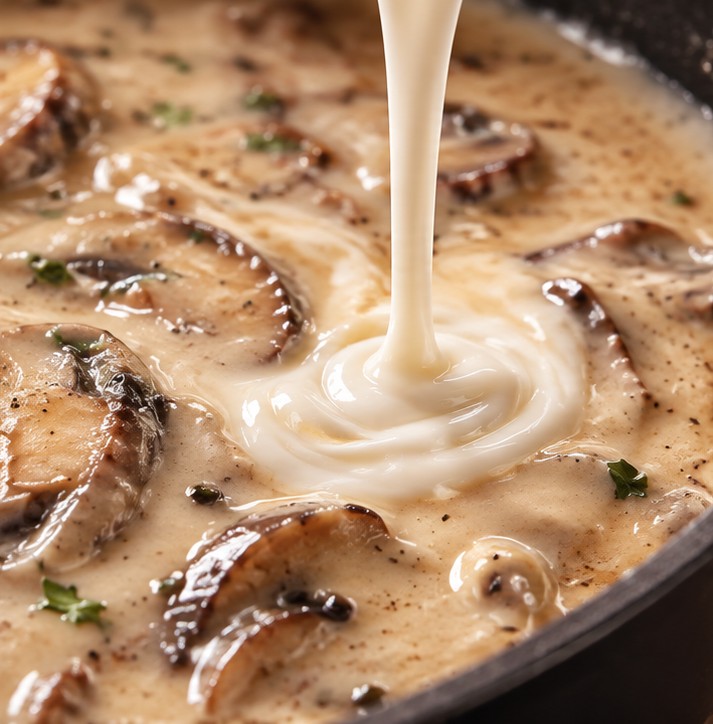
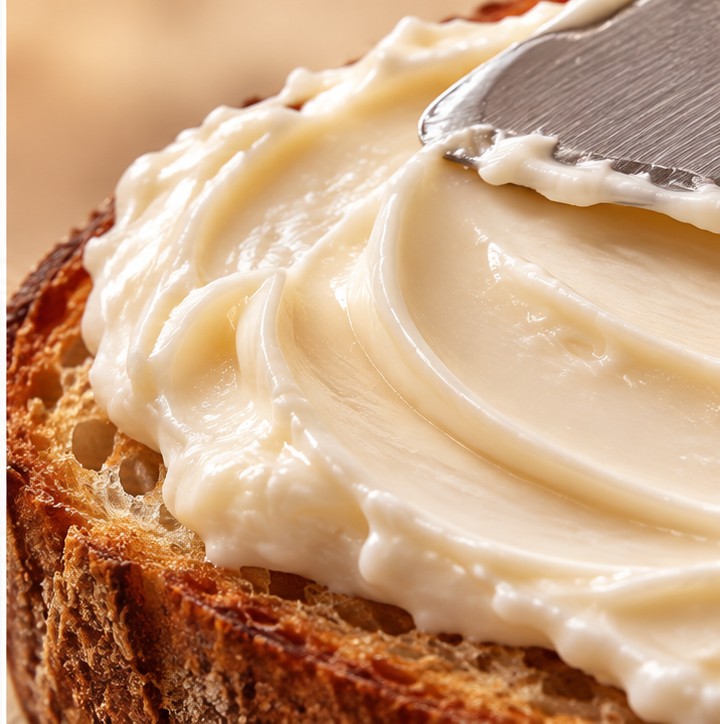
The food photography illustrates the applications. It is not a photograph of measured trial results.

01 / APPLICATION EXAMPLE
Mayonnaise & sauces
Create egg-free mayonnaise with rich, creamy texture and a simpler emulsifying system.
- Reported formulation result
- An internal formulation made without eggs, added starch or gums.
- Evaluation context
- This formulation is a starting point for evaluation. Oil level, the complete recipe and processing conditions need to be assessed together.
- Next step
- Compare eating quality, texture, stability and complete recipe cost against your reference mayonnaise.
02 / APPLICATION EXAMPLE
Plant-based cooking creams
Bring emulsification and cooking stability to a plant-based cream, with the body and sauce coating the product needs.
- Reported formulation result
- A cooking-cream formulation made without added lecithin, starch or gums.
- Evaluation context
- Cooking performance must be assessed under the intended recipe, heating conditions and use. The example does not establish suitability for every heat treatment.
- Next step
- Agree the intended cooking conditions and assess emulsion stability, richness and sauce coating.
03 / APPLICATION EXAMPLE
Plant-based spreads
Create a smooth, spreadable texture while balancing creaminess, firmness and a simpler ingredient list.
- Reported formulation result
- Spreadable prototypes with complementary protein and citrus fibre.
- Evaluation context
- The result reflects the combined formulation, including the complementary protein and citrus fibre; it is not a ChickBumin-only system.
- Next step
- Evaluate spreadability, firmness, sensory quality and chilled storage in your target recipe.
COST IN USE
Compare the complete recipe.
Ingredient price alone does not show the cost of a finished product. A side-by-side evaluation should use the agreed dosage, oil level, supporting ingredients, production conditions and volumes. Assess the economics alongside taste, texture and stability.
No standard saving is assumed: the comparison depends on your benchmark and target formulation.
Discuss your formulation